The Icebox Before the Home Refrigerator
See how the icebox shaped food storage in eastern kitchens, from placing a block of ice to planning meals around a cabinet’s limits and local supplies.
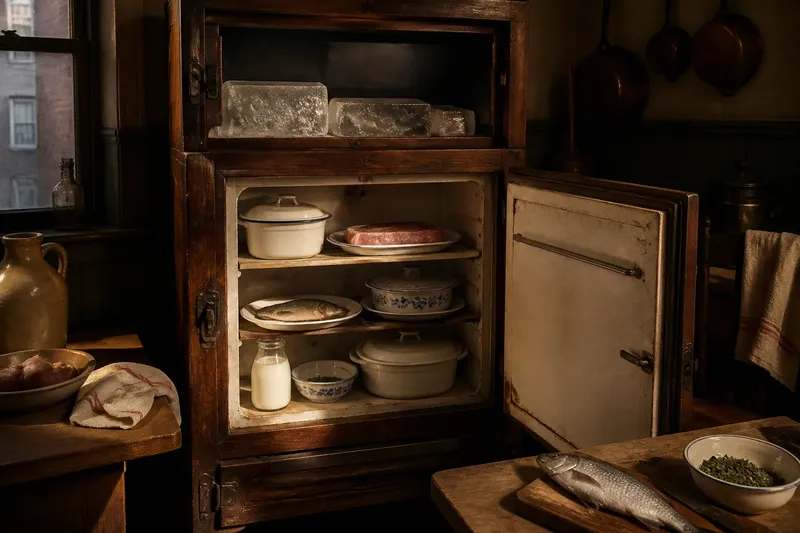
The common mistake is to treat the icebox as a refrigerator with a different name. In early twentieth-century New York, a wooden cabinet cooled by a block of ice made cold storage part of the household routine: food had to be placed, meltwater managed and meals planned around the cabinet’s limits.
How did an icebox work in an eastern city?
Domestic iceboxes were built in different forms, but many had an insulated cabinet, shelves for food and a separate compartment for ice. In an upper-ice design, cold air sank towards the shelves while warmer air moved upwards and escaped through a vent. A drain or pan collected meltwater.
New York offers a concrete regional setting for this arrangement. In the early twentieth century, city households could obtain ice through commercial supply and delivery, although access and routines differed by neighbourhood and household. The icebox depended on that supply: the cabinet did not make its own cold, and a household had to deal with the ice and water it produced.
Cooling was not uniform from shelf to shelf, nor constant as the ice melted. The box’s construction, how full it was and how often its door opened all affected its conditions. A cook learned the cabinet’s habits rather than setting a precise temperature.
What foods went into the icebox?
The icebox provided a cool place for food intended for near-term use, not a way to keep everything indefinitely. A household might place milk, meat, fish or prepared dishes inside, while dry goods stayed in cupboards. Salting, drying and pickling remained useful for foods meant to keep by other means.
Space was limited, and the ice itself occupied part of the cabinet. A covered dish helped contain spills and odours; placing raw ingredients apart from ready-to-eat food was sensible kitchen practice. The arrangement depended on the cabinet, the ingredients and the meal ahead.
For eastern city households, the icebox fitted around existing ways of buying and cooking rather than replacing them. Market trips, seasonal provisions and family meal customs still shaped what went into the cabinet. Cold storage offered a buffer between purchase and cooking, not a new menu by itself.
Why did the icebox add work?
Someone had to receive and move the ice, put it in the compartment, monitor the meltwater and clean the cabinet. The work varied with the household and its access to ice. A block did not quietly replenish itself; kitchens had to accommodate both its weight and the water it left behind.
Food placement also required attention. Frequently used items needed to be reachable without leaving the door open, and the cook had to learn which shelves stayed colder. These small decisions were part of managing a meal, not an optional exercise in cabinet tidiness.
Say a New York household buys fish in the morning for supper and has an icebox with an upper ice compartment. The cook places the fish in a covered dish on a cool shelf, keeps it apart from cooked food and plans to use it that evening. The result is a meal plan that accounts for the cabinet’s limited, changing conditions rather than treating it as a modern refrigerator.
How did ice supply shape household routines?
An icebox linked the kitchen to a supply beyond the home. In New York, commercial delivery was one route by which households obtained ice; the service and its reliability were not identical across the city. A household without convenient access faced a different routine from one able to arrange regular delivery.
The cabinet needed a suitable place, a reachable ice compartment and a way to collect or drain water. Those practical requirements shaped where it could sit and how people used the kitchen around it. Ice supply was part of the food-storage system, not merely a detail outside the door.
What do readers ask about the icebox?
Was an icebox the same as a refrigerator?
It served a related household purpose, but a block of ice cooled the cabinet instead of a powered refrigeration system. The household had to manage the ice and the meltwater.
Where did the ice sit?
In many designs, it sat in a compartment above the food shelves, allowing cool air to sink. Other layouts existed, so the position depended on the cabinet.
Could an icebox keep food indefinitely?
No. It offered cool storage for food intended for near-term use, while longer keeping often relied on methods such as drying, salting or pickling.
Why did households move to refrigerators?
Electric refrigerators produced cooling within the appliance and removed the need to replenish a block of ice. The change happened gradually, with household circumstances and access shaping when it took place.
How did the icebox fit eastern food traditions?
Across eastern communities, ingredients and meal customs varied, so an icebox did not dictate what belonged on the table. It could make it easier to keep dairy cool, hold a prepared dish until mealtime or store ingredients bought ahead. Older preservation methods continued to serve different needs.
It is not worth romanticising the icebox as a simpler kitchen. Its cooling varied, and its chores were real. Its place in food history is clearer when the cabinet is understood as one part of a local system of supplies, household labour and meals.
The refrigerator changed that system by making cold storage less dependent on delivered ice, but kitchens still needed organisation and care. The icebox shows how a food-storage tool could connect a household to the services of its city and shape the ordinary work behind a meal.