Why Traditional Dishes Rarely Have One True Version
Traditional dishes rarely have one true version. Learn how household, regional and occasion-based variations fit a dish’s history without erasing its roots.
The common mistake with a traditional dish is to look for one authoritative recipe and treat every variation as a mistake. That search for a single correct version of a traditional dish can flatten the very thing that gives it meaning: the way people cook it at home, in a particular place, for a particular occasion.
A recipe can record one cook’s choices, but it cannot stand in for every kitchen that has made the dish. Ingredients shift with local harvests, household means and taste; methods travel with people. The more useful question is not which version wins, but what each version tells us.
Why do traditional dishes have more than one version?
Traditional dishes vary because they are practices, not sealed formulas. A household learns a dish by watching someone cook, tasting along the way and adapting to what is available. Those lessons are often remembered as cues—until the onions smell sweet, until the dough feels soft—rather than as a fixed list of quantities.
That kind of knowledge makes room for difference. One cook may use a particular cut of meat because it suits the family’s budget; another may choose a vegetable that grows nearby. A dish’s name can remain stable even as its ingredients, texture or method change across households.
Migration adds another layer. Cooks take familiar dishes to new places, where an ingredient may be hard to find or a local substitute becomes appealing. Over time, the changed version can become ordinary within that community. It is not necessarily an imitation waiting to be corrected. It may be part of the dish’s continuing story.
What makes a version regional rather than simply personal?
A regional version tends to reflect habits shared across a place: ingredients that are easy to obtain, established ways of cooking, and preferences learned through repeated meals. No single feature has to define it. Rather, several choices may cluster together, giving a local version a recognisable character.
That distinction is not a border drawn on a map. Neighbouring communities exchange recipes, families move, and markets connect places. A dish may change gradually as one travels, with no sensible point at which it stops being one version and becomes another.
Nor does a region have to speak with one culinary voice. A city, a rural area and a coastal community may each claim a local form of the same dish, while families within them make further adjustments. Calling one of these “the regional version” can be useful shorthand, but it should not imply that everyone nearby cooks it identically.
How do household recipes belong to a dish’s tradition?
Household recipes are often where tradition is most actively maintained. A cook may preserve a particular texture, sequence or seasoning because that is how a parent or grandparent taught it. Another family may make a different choice and attach equal importance to the result.
These recipes can carry practical knowledge as well as memory. A household may know how to adapt a dish for a large family meal, a small kitchen or an ingredient that is only available at certain times. Such adjustments are not always recorded in cookbooks. They still shape what people recognise as the dish.
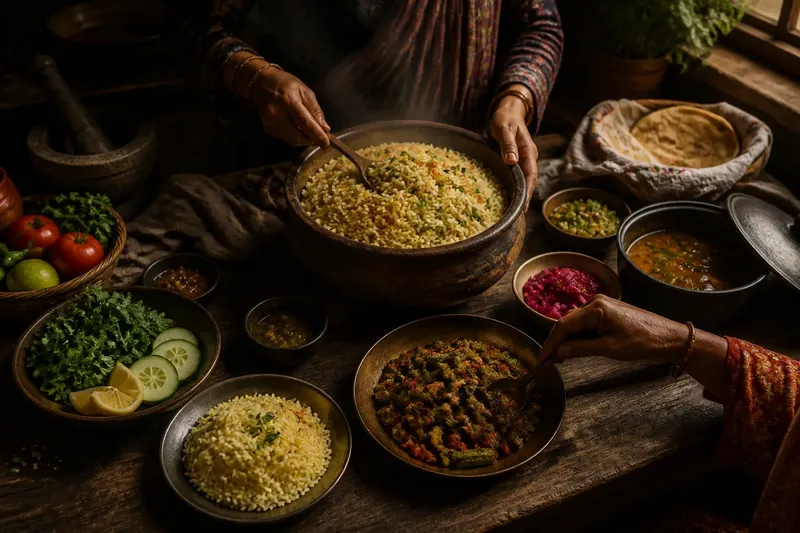
Say you inherit a recipe for a rice-and-vegetable dish, but your family has always added a sharp pickle at the table. You might keep the rice method and vegetable mixture intact while serving the pickle separately, as your relatives did. The expected observable result is a meal that preserves the household’s familiar flavour contrast without claiming that every cook must serve it that way.
When describing a family version, name it honestly: “our household’s version” is more precise than “the original” unless there is good reason to make a historical claim. That small choice respects both the recipe’s importance and the existence of other kitchens.
Why can the same dish change for different occasions?
Occasion changes a dish’s role, and sometimes its form. A weekday preparation may be modest and quick; a version for a wedding, religious observance or community gathering may use ingredients associated with celebration, or be made in a quantity suited to sharing.
Rules and expectations can also shape what belongs in the pot. Fasting periods, dietary practices, seasonal customs and the availability of particular ingredients all influence how a dish is prepared. A version made for one occasion may be understood as distinct without being treated as a rival to the everyday one.
The setting matters, too. Food served at a family gathering may be seasoned for familiar tastes, while a version prepared for guests may reflect another household’s preferences or a local custom of hospitality. These are not merely decorative changes. They show how cooks use food to mark relationships and moments.
How can you tell a meaningful variation from a careless claim?
A variation can be part of a dish’s tradition without every claim about it being equally sound. Look for context: who makes the version, where it is associated, what occasion it serves and how the cook describes its connection to other forms. Specific, modest accounts are generally more informative than grand claims of exclusive ownership.
It also helps to separate a recipe’s documented history from a family’s account of its own practice. A family may know that a dish has been made in a certain way across generations. That is valuable testimony about the family’s tradition, but it does not automatically establish that the same method is universal or the earliest form.
When reading a recipe or menu, ask:
- Is the version tied to a particular household, locality or occasion?
- Does the writer explain which choices are customary and which are personal?
- Are ingredients described as essential, common or simply available?
- Does the account acknowledge neighbouring or related versions?
- Is a claim about origin supported with context, or presented as a contest to be won?
These questions do not require a verdict. They help identify what kind of claim is being made, which is often more useful than deciding whether a dish has passed an imaginary authenticity test.
Does changing an ingredient make a dish inauthentic?
Not automatically. A substitution may reflect a long-standing local practice, a household’s needs or a cook’s adaptation to a new place. The relevant question is what the change does to the dish and how the cook understands it—not whether a single ingredient has been replaced.
Some ingredients do carry particular significance, and changing them may produce a version that differs substantially from the one a community associates with the dish. It is fair to describe that difference plainly. It is less useful to assume that any departure makes the food fraudulent.
There is a difference between adapting a dish and presenting an adaptation as the sole traditional form. A cook can make a personal version freely while describing it as such. That leaves room for invention without overwriting the practices that inspired it.
How should a recipe describe its own version?
A recipe is clearest when it states what it represents. It might say that it follows a particular household method, reflects one locality, or offers a contemporary adaptation. Naming the scope gives readers a useful frame without pretending that one written recipe contains every version.
It can also distinguish between the dish’s central character and flexible choices. For instance, a recipe might explain that a certain texture is the family’s preference while noting that cooks in the same area use different vegetables. This tells the reader what matters to that cook and where variation is expected.
What is not worth the effort is trying to crown a winner by comparing isolated ingredient lists. A list cannot tell you whether a dish was made for a celebration, adapted for a new home or passed down with a particular family story. Context is not garnish.
What do readers often ask about traditional dishes?
Can a dish have several authentic versions?
Yes. Authenticity can describe a real connection to a household, community or cooking tradition; it need not mean that every version is identical. The useful detail is whose practice the version represents.
Is the oldest recipe always the most authentic?
Not necessarily. An old written recipe records one account at one point in time, while oral and household practices may not appear in print. Age alone does not make a recipe the only valid form.
Can a version created abroad still belong to the dish’s story?
It can, especially when cooks have carried the dish into a new setting and adapted it over time. It is helpful to describe the place and circumstances of that version rather than treating change as evidence of failure.
Should a traditional recipe be changed to suit personal taste?
A cook may adapt a recipe, then describe the result as a personal version. That wording makes the choice clear and leaves the traditional forms around it visible.
The phrase “traditional dish” need not point to a single recipe. For a reader trying to understand a traditional dish, the more revealing clues are who cooks it, where it is made, when it is served and what the cook considers worth preserving. A dish can have a recognisable identity without a single authorised formula, and its variations often show how that identity travels from one table to another.